
Estimated reading time: 6 minutes
Choosing stair lifts for narrow stairs is complex. Space constraints matter. User dimensions matter. Your staircase configuration matters. This guide provides a practical framework for selecting the right solution. You’ll invest in equipment that genuinely meets your mobility needs, not settle for a compromise that leaves gaps in your staircase or blocks access for others. Before exploring your options, understand the full range of stairlifts available today.
How Do I Know If My Staircase Is Too Narrow for a Standard Stairlift?
Here’s the thing: your staircase width alone doesn’t tell the whole story. It’s about the relationship between that width and the user’s seated dimensions.
The 5-Step Assessment Framework
Step 1: Measure Your Staircase
Find the narrowest point between walls or banisters. Staircases under 700mm typically need specialist solutions. Those over 800mm usually fit standard models.
Step 2: Calculate User Requirements
Measure from the user’s spine to their knees when seated. Or to their toes if legs are extended.
Does this measurement exceed your staircase width? You’ll need a compact or specialist model.
Step 3: Consider Other Household Members
Think about the stairlift’s folded depth. When not in use, it should leave enough space for others to use the stairs safely.
Step 4: Account for Curves and Landings
Curved staircases reduce width at bends. Measure the narrowest point on the inside of any curves. This determines whether you need rotating seat technology.
Step 5: Evaluate Physical Capabilities
Can the user sit comfortably with knees bent? If not, standing or perch lifts may work better than seated models. Staircase width becomes less relevant.
Staircase Width Guide
| Staircase Width | Typical Solution |
| Under 640mm | May require structural changes or alternative mobility solutions |
| 640mm to 699mm | Specialist rotating seat models only (e.g. Flow X) |
| 700mm to 799mm | Compact models with folding components |
| 800mm+ | Most standard stairlift models work |
What Are the Green Flags and Red Flags When Choosing Stair Lifts for Narrow Stairs?
Understanding the difference between quality solutions and common mistakes can save you money. It can also prevent dangerous compromises.
✓ Green Flags: What Good Looks Like
Rotating Seat Technology
The seat automatically swivels at curves. This minimises the knee-to-wall distance. The Flow X stairlift handles staircases as narrow as 640mm.
Foldable Components
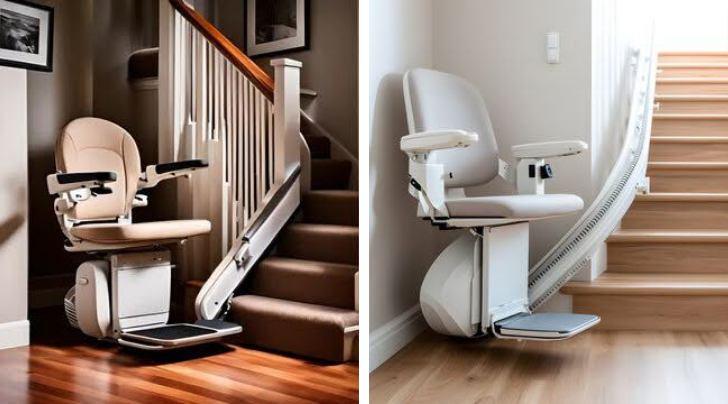
Armrests, seats and footplates should fold away neatly. This preserves staircase access for others when you’re not using the lift.
Custom Rail Profiling
Your track is manufactured specifically for your staircase, not adapted from standard components. Big difference.
Ultra-Slim Rail Systems
Slimmer rails maximise the remaining staircase width. The Otolift Air Smart has a 60mm rail. That’s the world’s thinnest.
Perch Seat Options
Some users struggle to bend their knees fully. Perch seats allow travel in a semi-standing position. This reduces the user’s depth.
Professional Site Surveys
Detailed measurements of both the staircase and the user before quotation. No guesswork.
Appropriate Weight Capacity
The manufacturer’s rating should comfortably exceed the user’s weight. This ensures safe operation with personal items and provides a safety margin.
Safety Features
Look for equipment with comprehensive safety systems. Good models protect both the user and other household members.
Clear Explanation of Limitations
Good suppliers tell you when equipment won’t work. The Platinum Ergo curved stairlift suits complex curves. But every model has constraints. Honest suppliers acknowledge this.
Genuine 24/7 Engineer Support
Response commitments in writing. Not just call centre access.
✗ Common Selection Mistakes
| Red Flag | Why It’s a Problem |
| Immediate suggestions to remove bannisters or alter your staircase | Shows the supplier can’t find proper equipment solutions |
| Fixed armrests or non-folding footplates. | Permanently obstructs the staircase width for other users. |
| One size fits all claims. | No two stairs are identical. Custom solutions matter. |
| Thick, bulky rail systems. | Unnecessarily consumes valuable space when slimmer alternatives exist. |
| Forcing users into seated positions. | Ignores whether standing or perching would work better. |
| Phone quotes without site visits. | Impossible to assess accurately without seeing the space. |
| Models at absolute weight capacity limits. | Leaves no safety margin for clothing, bags or future changes. |
| Basic safety features only. | Doesn’t consider household traffic patterns. |
| Downplaying limitations. | Suggests that the equipment will work in marginal situations without proper assessment. |
| Vague support promises. | “Support available” means nothing without specific response times. |
Most narrow-staircase problems require engineering solutions, not compromises.
The right supplier acknowledges when standard equipment won’t work. They propose alternatives. They don’t force inadequate solutions into complex spaces.
Why Choose Obam for Your Narrow Staircase Solution?
We’ve specialised in solving challenging installations since 2000. From 640mm staircases to complex multi-level installations with minimal clearance.
Here’s what makes us different:
Access to Every Major Manufacturer
We match equipment to your circumstances. We don’t force your circumstances to fit our limited inventory. As an independent distributor, we can source the best solution for your specific needs.
Manufacturer-Trained Engineers
Our team knows the equipment inside out. They’ve handled configurations across Lincolnshire, Nottinghamshire and beyond.
True 24/7 Emergency Support
Not a call centre. Direct access to engineers who can fix problems. We’re on hand 365 days a year.
Over 100 Five-Star Reviews
From customers whose narrow staircases initially seemed challenging. We’ve built our reputation on finding solutions.
Honest Guidance
We’ll tell you if a stairlift isn’t the correct answer. Sometimes it’s not. We only employ salaried surveyor-advisors, not salespeople. They’ll find the best solution for you, not just sell you the most expensive model.
Get in touch with our team for a free, no-obligation survey. We’ll measure your staircase properly. We’ll assess your specific mobility needs. And we’ll provide honest guidance on which solutions will genuinely work.
Frequently Asked Questions
What is the minimum staircase width for a stairlift installation?
The minimum is generally 700mm for standard models. However, specialist equipment like the Flow X can accommodate staircases as narrow as 640mm. It uses rotating seat technology that angles your knees during curves. This minimises the gap between the knees and the wall.
Are curved stairlifts suitable for narrow staircases?
Curved stairlifts are often better for narrow staircases. The custom rail follows your exact staircase profile. Rotating seat technology reduces your depth at tight curves where space is most constrained. This makes them more suitable than fitting straight models.
What are the alternatives to standard stairlifts for very narrow stairs?
Alternatives include perch lifts for users who can travel semi-standing, ultra-compact models with rotating seats like the Flow X, standing stairlifts for those with flexibility limitations, or through-floor lifts if staircase installation proves impossible due to dimension constraints.
How much do stair lifts for narrow stairs typically cost?
Specialist narrow staircase solutions typically cost more than standard equivalents because they require custom rail manufacturing, rotating seat mechanisms and ultra-slim components. For accurate pricing specific to your situation, contact us for a free survey and quote. Every installation is different.
Can you install a stairlift without removing the banister on narrow stairs?
Stairlifts attach to stair treads rather than walls or banisters. So bannister removal is rarely necessary, even on narrow staircases. However, the bannister’s position affects which side the rail mounts on. It may also determine whether post-modifications are required for optimal positioning.